
The challenge
At Companies House the challenge was to enable users to submit paper applications to the organisation during the COVID-19 pandemic that could no longer be received on paper. Because of the pandemic and the lockdowns it was hard for citizens to get access to equipment and the local post offices and for the staff because they were working from home it was difficult to distribute paper forms to them for processing.
My role
My role was to design an accessible service that could be expanded over time to allow over 600 different paper forms to be submitted digitally. The project started in March 2020 and finished in June 2021. As Senior Interaction Designer, I was responsible for prototyping, providing frontend development support by working with developers and analysing user research feedback and iterating designs.
The approach
As this was an emergency service the discovery was short, lasting just one week. In that time we assessed the impact of going into lockdown for the organisation to continue processing paper applications.
The team identified that there were over 600 different paper forms, that collectively are submitted over 1 million times a year, with no digital offering.
During this discovery I was responsible for user journey mapping the current as-is process. This journey map highlighted problem areas such as:
- How could someone fill in and submit a paper form at home if they no longer have access to a printer? Would access to technology be a barrier?
- How could someone leave their home during lockdown to post a form that was time sensitive? Would mobility and access to a local post office or post box restrict people?
I also looked at the internal problem areas, such as:
- How could the operations team get access to posted forms that are sent to the organisation building if they are working from home?
- How can staff scan and process documents at home without office equipment and access?
Clearly we had problems, pain points and questions, as well as a time pressure and a sense of uncertainty.
We couldn’t solve all of the problems in one go, we also knew that we couldn’t deliver a service that had the complex routing for over 600 paper forms.
Working with stakeholders including service owners, product managers and directors as well as the operations leader, we distilled it down to 6 form types that needed to be released in the first version.
With this in mind, I then worked with the technical architect and data analyst to determine what details we needed to capture from the user alongside the uploaded document which led to developing our minimum viable product (MVP).
Alpha and minimum viable product
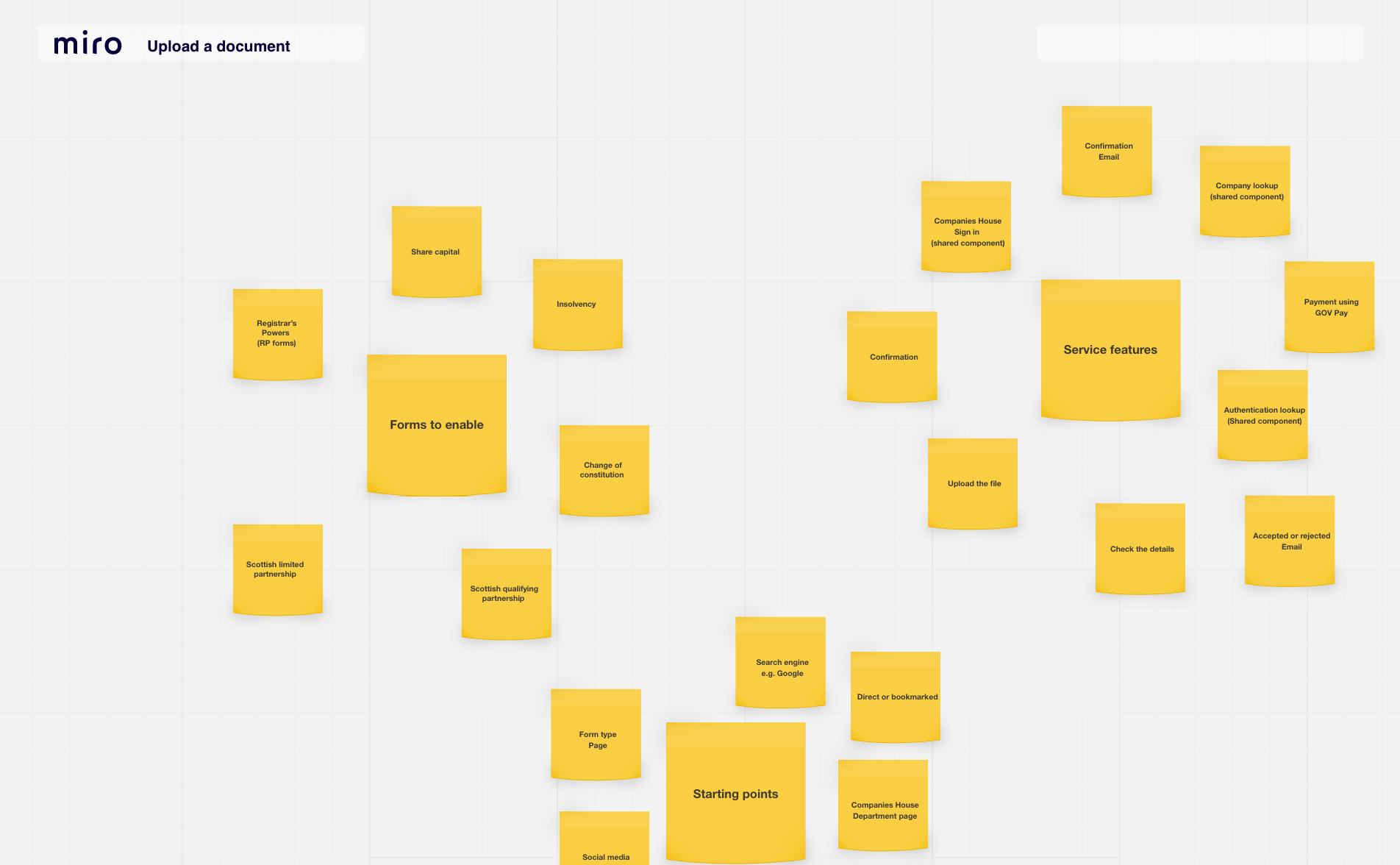
With our short discovery over we now needed to get version one out to users as soon as possible. Using the GOV.UK Prototype Kit I worked with the content designer to create a one-page service that balanced the business needs as well as keeping it simple.
The one-page solution contained:
- a company number text field – in order to provide the unique code for each company
- the 6 different form types as radio options
- an upload selection for the completed document
- a button to submit the uploaded document that was then emailed to the relevant team
Within the same week, I worked with the developers, testers, and technical architects to turn the prototype into a fully functional service. I was responsible for the frontend development as well as the prototyping for this first version
This was deployed by the end of the week, with users starting to use it the same day. Carl Allen, who was the technical architect on the project, had some kind words to say about our time working together:
“I worked with Michael in designing the user interfaces for systems during the COVID-19 outbreak. Michael is very knowledgeable in his UX specialism. He is adept at quickly assembling components and using HTML, Node and preparing services using the GOV UK toolkit.
He demonstrated great enthusiasm in rapidly producing working prototypes, quickly adapting and amending them as the design developed.
During the emergency he also assisted the development team in getting things into the production environment when resources were stretched. Michael is able to coach less experienced colleagues to produce high quality products.
He is adaptable, professional and very easy to work with and would be an asset to any team”
– Carl Allen, Enterprise Architect
The benefit of this quick and agile workflow meant it took the pressure off the service team, who could instead focus on enabling more form types.
Users were able to file these forms successfully and we made a few changes after release to the one-page solution to add a feedback link to gather user feedback.
I made suggestions to the feedback form to ask a question about which form types a user would like to see through this service as this would help us prioritise which form types to focus on next.
Alpha for the multi-page service
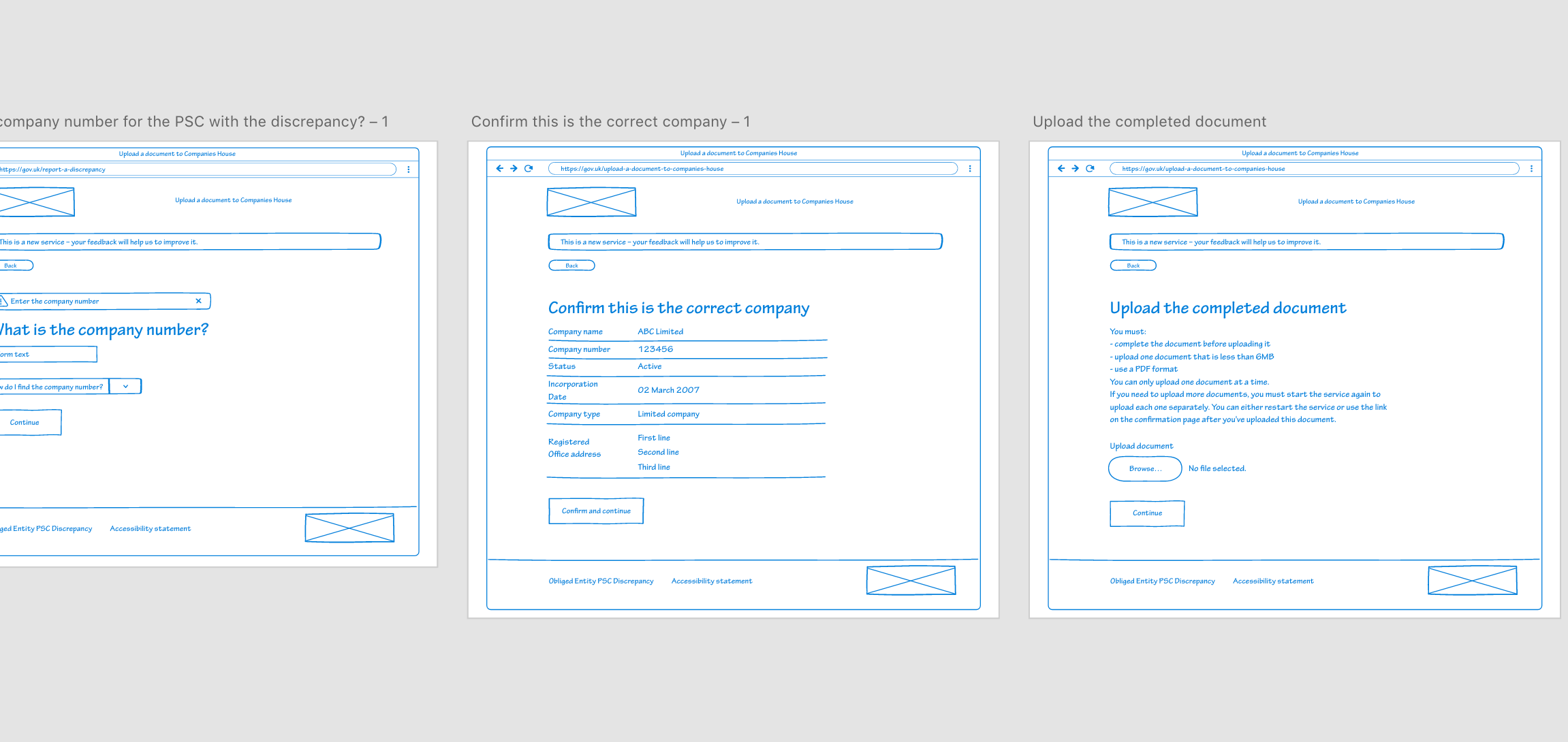
Now that version one had been released and the highest priority form types were being submitted and basic feedback was being gathered, we focused on expanding the service.
We considered a number of options:
- Email solution (allow users to send emails with the form attached) – problems: volumes and different form types were problematic, no confirmation of receipt (users need an audit trail), increased risk of entering data for wrong company or missing fillings, not end-to-end (did not integrate with internal service), security implications with forms containing personal data.
- Full digital journey with data input – problem: would take too long to digitally enable 100s of forms in an emergency.
- A simple upload facility – solution: users select form type, correct company details and integrate with existing components.
The user-centred design team consisted of myself as the interaction designer, a content designer and two user researchers. We held regular weekly user-centred design (UCD) meetings where we discussed:
- prototype changes
- upcoming user research sessions
- feedback from users
- user personas
When the project closed in June 2021, we ended up making more than 500 changes to the prototype, and we held over 100 user research sessions including sessions with users who have assisted digital needs, and expanding the service to allow for over 400 form types.
Information architecture

An important part of my role for this service was information architecture. It was a challenge for this service because as more form types were enabled it meant the number of options increased. The one-page solution worked well for a handful of form types, but how do you design for over 400 different options?
The solution was not to reinvent the wheel but use the same structure and lean on the user’s mental model of how the forms should be structured. We created a step-by-step filtering system that had categories and (where applicable) subcategory pages. Then users could filter down to the form types within those categories.
We did consider other options such as using a dropdown menu with an autocomplete function, but this was not possible at the time and we could not be certain it would be fully accessible. There is some design debt with the solution we created in the end, but this was added to the backlog to then be picked up in the future.
Measuring success
As well as working with the user researchers, I worked with the performance analyst to determine our key metrics, which were:
- time from pressing the ‘Start now’ button to submitting a document (the completion rate)
- people landing on the page and dropping off immediately (bounce rate), in particular on the form types of pages
- errors on uploading the completed the document
These analytics were essential as we made many changes based on the statistics. Because of these changes, our completion rates went up throughout the year, going from around 20% to near 70% in four months.
This was extremely positive as we were also adding more forms at the same time, so we managed to improve the completion rates as well as expand the service which is something that is not always possible.
I worked with the developers and product manager to prioritise the scrum backlog. We had to balance the backlog to have a mix of stories that fixed technical and design debt and introduced new features that met user or business needs.
The wider picture
As this was a new service it was important to consider how people would discover this service, especially during the pandemic. People were already confused and uncertain about what was happening around them and how to do their jobs. We needed to communicate to users that instead of posting documents you can now submit them online.
Starting point
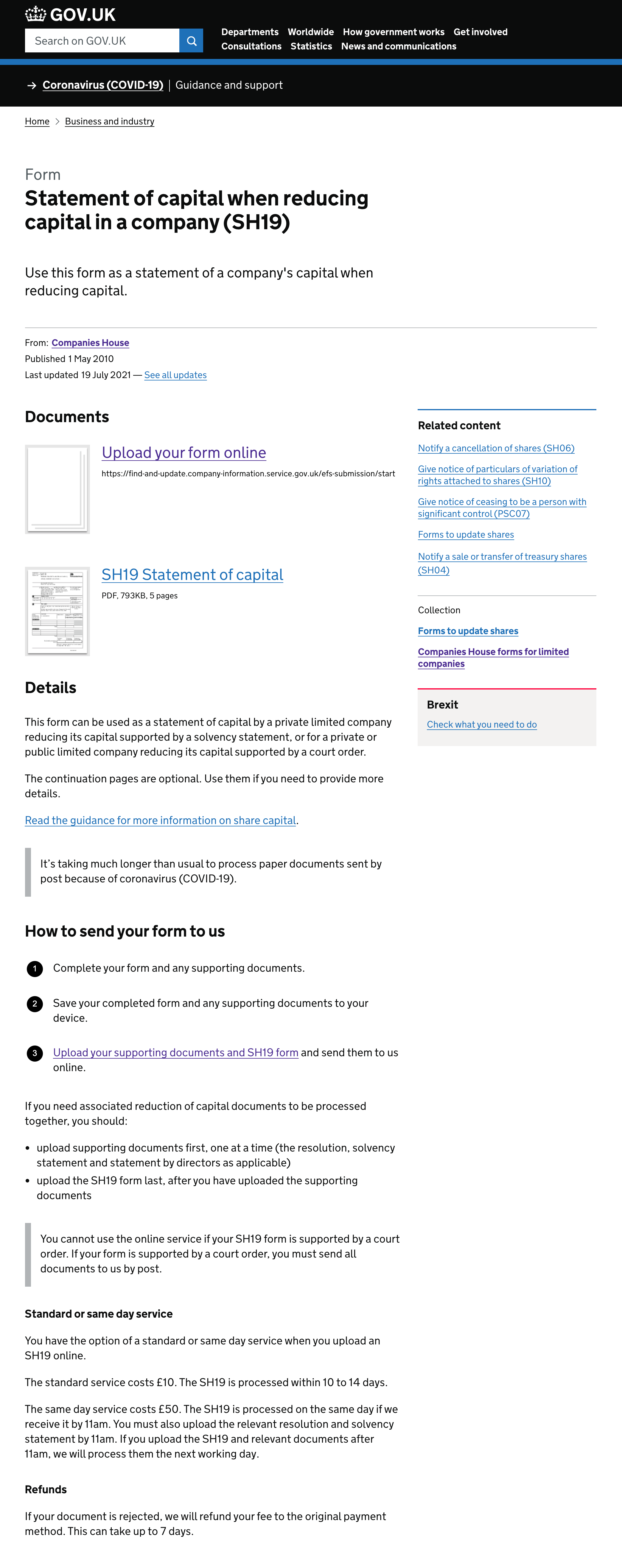
As well as designing the service, I worked with the content designer to identify the starting places of this service. We found all the pages that contained forms users can submit using the upload service. On these pages, we needed to make it clear to the user what they needed to do – complete the form and save it to the device you will be uploading from, then include a link to the upload service.
We also worked with our communications team to talk about the new service through social media and blog posts. To also manage users expectations, we created an article page that had 3 sections:
- What forms have been enabled
- What forms will be enabled soon
- What forms will be released in the future
This helped reduce customer contact and reduced frustration as users then knew what was possible to upload. Especially as this service was ever-changing, communication was essential to the success of this service.
Exit
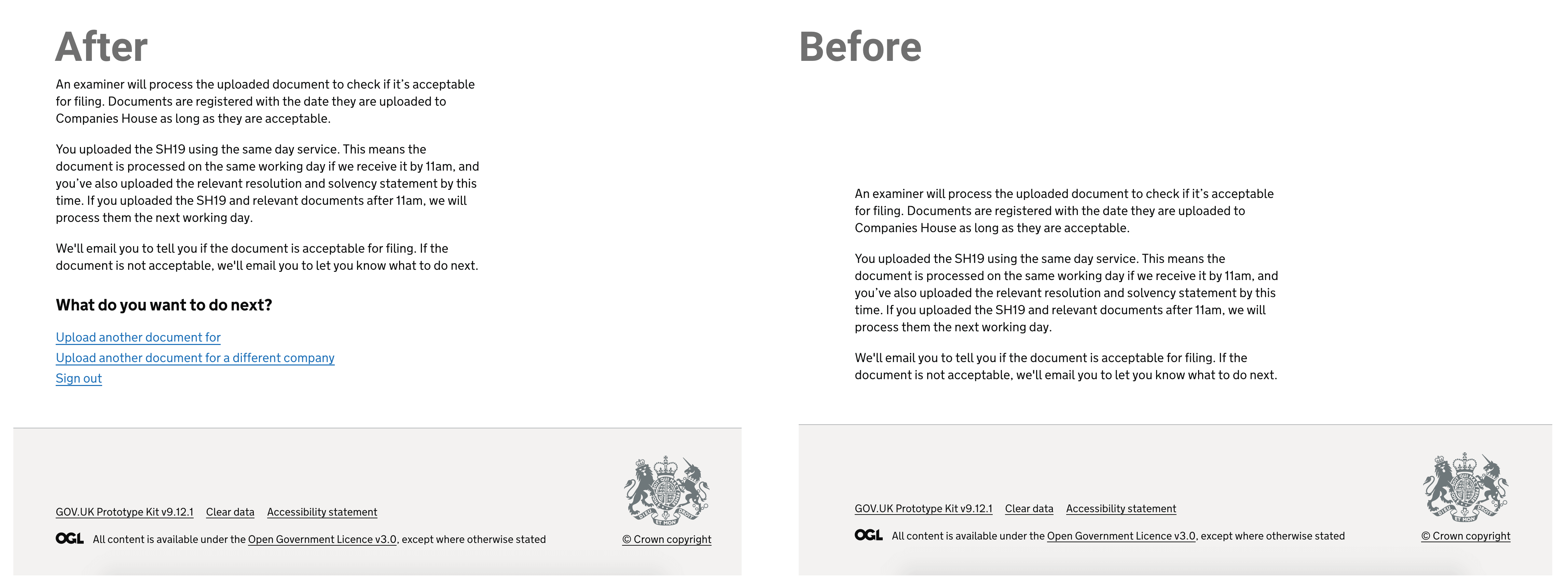
Another area we focused on was the exit for the service. We found out through user research that users had 3 goals after submitting a completed document:
- Upload a document for a different company
- Upload a document for the same company
- Leave the service
The content designer and I iterated our confirmation page to have a new section called “What do you want to do next?” with those three links.
What I learned
This was an unique situation both at an individual and organisational level. One learning was how to negotiate and work with stakeholders to make sure the scope is right, reducing the scope down to 6 forms at the start meant that we avoided stress and made it manageable.
The next learning was the work with the performance analyst was essential, capturing data early helped us with the iterations with the service and measuring success.
The final learning was the importance of documenting design decisions and version history of the design and prototypes. Because of the speed it meant that we had to make tactical short-term decisions, which later in the project needed to be re-worked.
The outcome
This service has developed a lot in a year, at a fast rate. Originally this service was meant to last just to deal with the pandemic and allow the business to carry on. However, it has become clear that this is a better process for users and the business as it allows users to upload and submit documents quicker than by post, as well as saving money on postage and printing. In terms of benefits for the business, it allows staff to work anywhere to do their jobs and it cuts down on the admin process.