
The report a discrepancy about beneficial owners on the PSC register service was introduced because of the Money Laundering and Terrorist Financing (Amendment) Regulations 2019. The task was to find a solution that allowed obliged entities (the users) to report any discrepancies between their data when onboarding new clients and the UK Government Company Register, to reduce misinformation and investigate any suspected money laundering.
My role was to investigate and design a way that allowed users to report discrepancies for new clients they were onboarding. There was a set deadline for the delivery of the service so it was important for me to be organised and strategic with my approach to the design, prioritising the essential product features.
Discovery and the challenges
The task was to create a service that allowed these obliged entities to make the reports. Three areas of focus during the discovery for the design were 1. looking at the entry points, 2. studying existing services or processes that allowed users to report discrepancies, and 3. discovering who the users are and their needs.
Entry points and existing services
As part of the discovery, one of my areas of focus was looking at the ways users can report discrepancies on the public register. The reason why I wanted to map out current processes and services is because I wanted see how this new policy could interact with that, rather than adding more complexity on top of existing business processes. I did this by working with stakeholders in the customer services team to fully understand how someone can submit a discrepancy to Companies House, current pain points and opportunities to merge this project in with any existing processes.
Through this investigation I found an existing generic service that allowed people to submit errors on the public register. However, this service would not be suitable for the policy as we needed to capture more details, and people would need to go through extra checks before submitting a discrepancy that they believed was involved in money laundering. This was one of the decision points around creating a new service. Another focus for the discovery was the users.
The users
Reducing the chances of money laundering is nothing new. Banks and accounting firms are used to going through their own checks and processes when onboarding clients. Where this new policy made a difference was that there would be industries that would be obligated to report discrepancies such as art dealers and real-estate firms. And all of the different industries would need to update their own processes to include making reports to Companies House, if needed.
This presented a problem – how aware were these organisations of the upcoming policy changes and how are they going to adapt their processes?
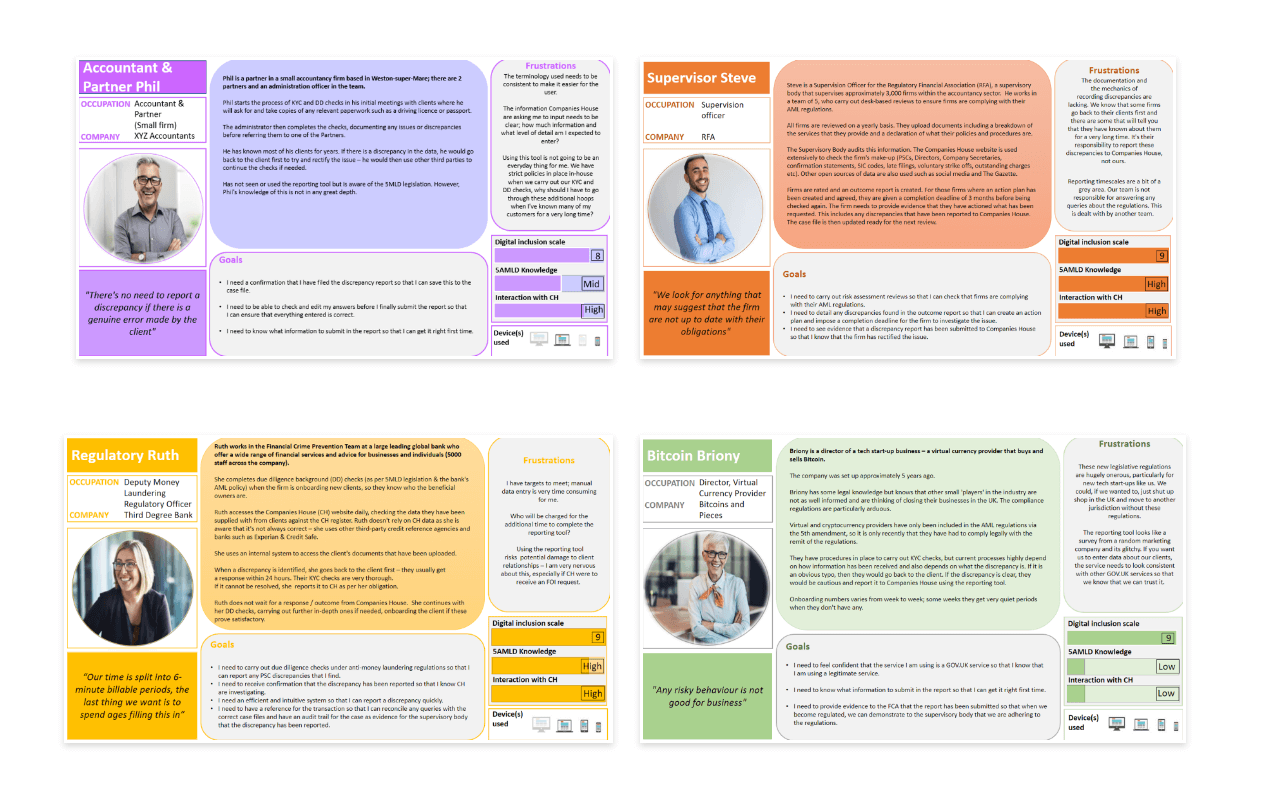
Working as a team we decided that we would need to do some field research and meet a range of users. We contacted the user research base and myself and two user-researchers went travelling for the day, speaking to a range of users. By going to the users and their places of work we then conducted an hour research session where we asked pre-set questions to understand what the upcoming policy changes meant for them. Through discovery we realised the following:
- Obliged entities had little knowledge or understanding of the upcoming Fifth anti-Money Laundering Directive (5MLD) regulations because the policy had not been written yet
- The solution had to be accessible to a range of users, from credit institutions who could make hundreds of reports a week to art dealers who may make one or two reports a year
- The solution had to be delivered by 10 January 2020 to meet the date the regulations came into force
Most of the time in discovery I was working with our policy and legal team to try to understand the policy objectives and the business needs. My approach was to conduct user interviews with these colleagues, which gave me insights into their understanding of the policy, and built a relationship with the team.
Alpha and my approach
Moving into Alpha, as senior interaction designer of the service I worked with a range of stakeholders to form what this service could look like.
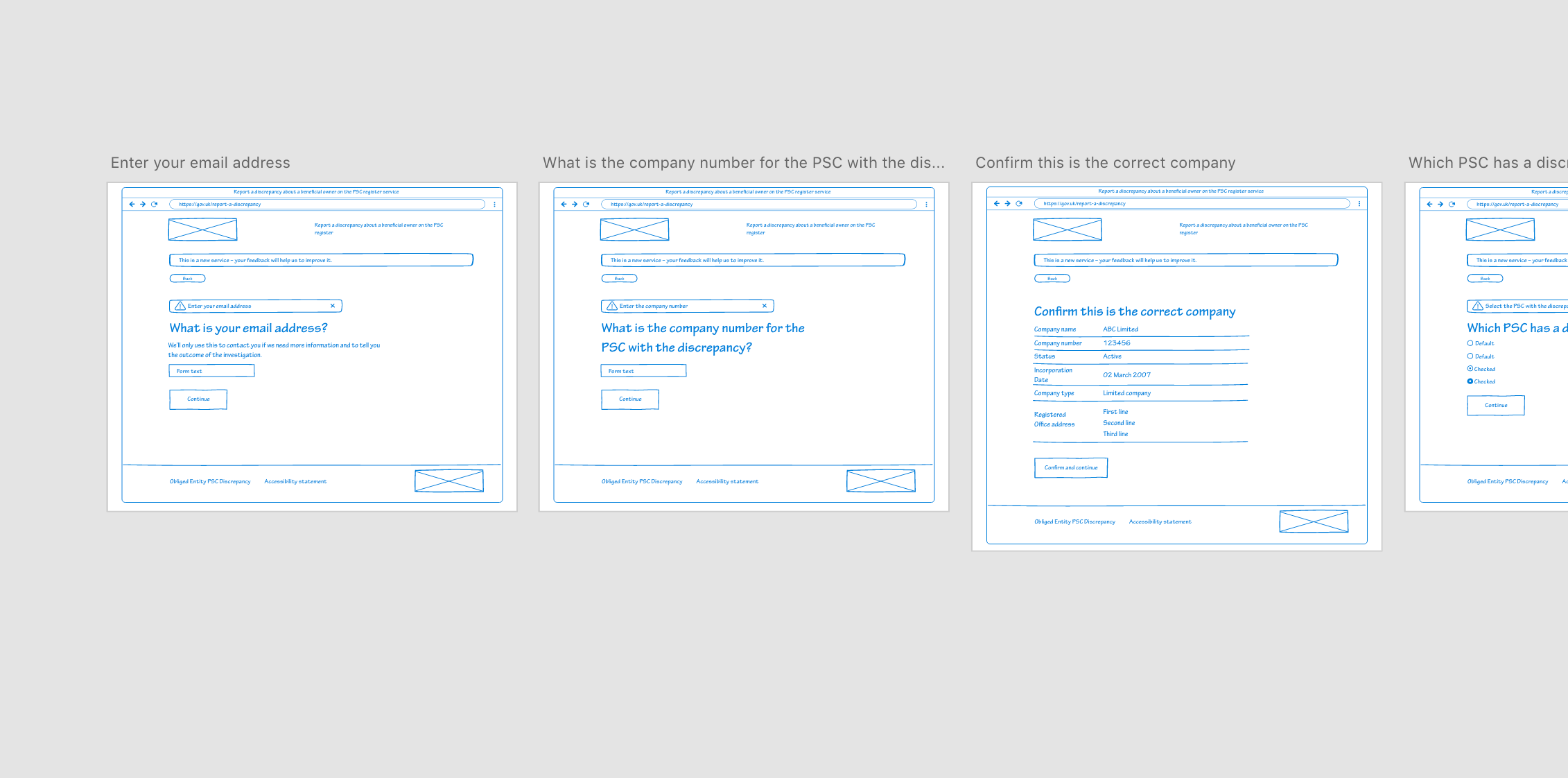
What I found as we were going through our design sprints is that users needed the tool to:
- Be quick, as the user will have to bill for their time filling this form out
- Provide a reference or some sort of confirmation statement detailing what has been submitted, alongside a reference number. This is because the users need to document this within their own organisation
- Have clear guidance that tells users all about the 5MLD regulations, such as when to make a report, what a discrepancy looks like and who has to make the report
With this in mind, I then worked with our policy colleagues and content designer to design the prototype to have the least amount of questions required. This involved using the GOV.UK Prototype Kit, as well as low-fidelity wireframes using Adobe XD. This iterative approach meant that we gradually built up the complexity of the prototype. Eventually I used Express JS and Javascript to add routing, validation and filtering to create a realistic representation of what the service could look like.
Another key change we made was merging the start page and guidance pages together to form a guidance start page – a learning we picked up from user research. This was an important design decision as it means users can see all of the guidance before starting the service and have the right information to hand before making a report.
As a team, we formed the following to help us in our design process:
- Personas – we identified four different personas based on user research and interviews
- Customer journey maps
- Prototype testing
We successfully passed the Alpha assessment and swiftly moved on to Beta.
Beta and developing the service
My role in Beta was to ensure that the prototype that was developed in Alpha was delivered as expected. This included end pages – such as if a user needs to report a discrepancy but the People with Significant Control are protected and so are not on the UK company register, we’d have an end page that tells the user how they can file the discrepancy instead.
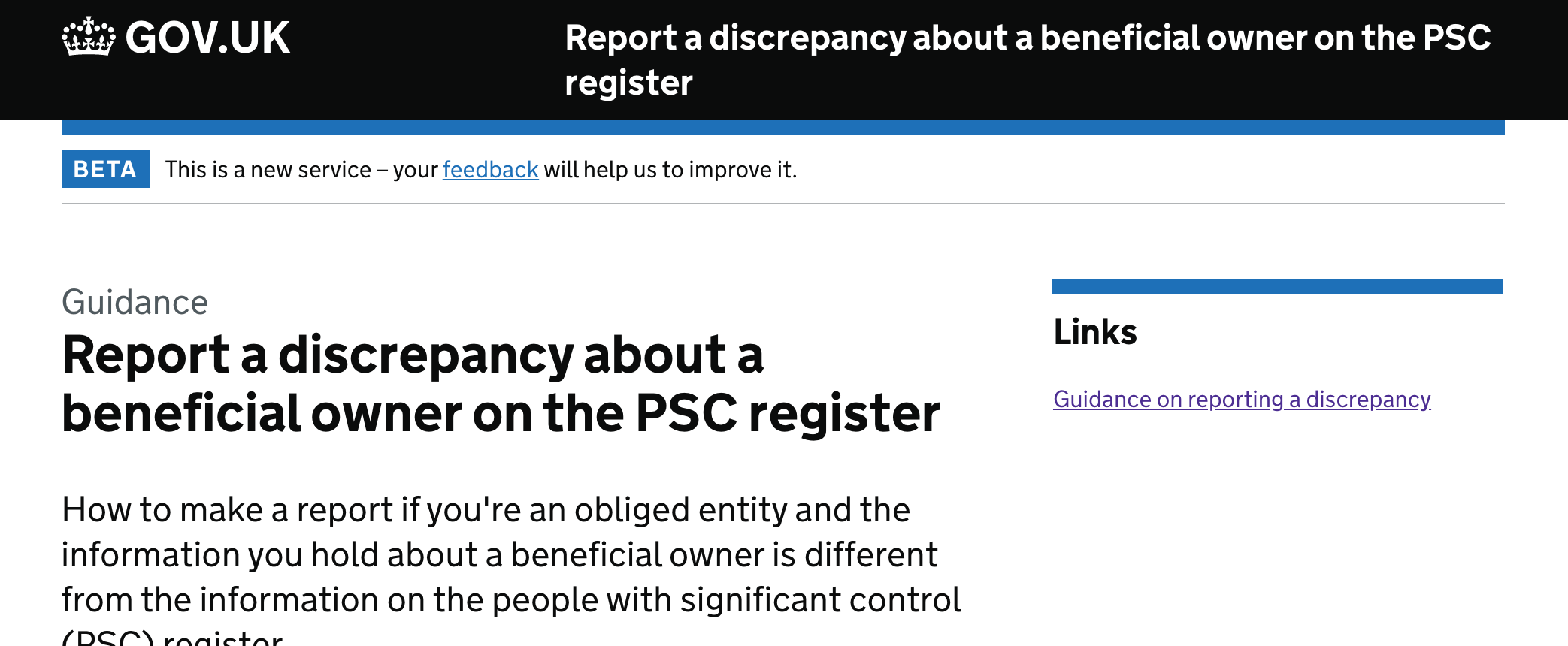
Another area I oversaw was ensuring that error validation was implemented correctly and even the smaller details such as the page titles are consistent and meet the GOV.UK standards and are accessible. I worked with Chloé Bayetti, a delivery manager at Companies House, and she kindly shared the following feedback on how I work in a scrum team:
I have the pleasure of working with Michael at Companies House. Michael has been a key agent in our scrum teams, providing quality designs and showing a great ability to adapt. Extremely smart and able, he embodies the Agile mindset and practices and also promotes personal development which has been a great contribution to CH so far!
Summary
The 5MLD service is now currently in private beta, receiving regular reports for obliged entities. This service required good collaboration with senior leaders and the wider scrum team to make sure that the policy was delivered in a user-friendly way. It was interesting to understand the user needs for this service, such as how important it was for the service to be as small as possible to save time and money.